


Can Your Business Stay Open During a Commercial Renovation?
Renovating a commercial space does not always mean closing the doors. Many offices, retail stores, fitness facilities, and other businesses can continue operating while construction takes place. The key is determining early which activities can happen alongside daily operations and which require temporary separation or downtime.
For owners and tenants, the question is not simply whether the business can stay open. It is whether the project can move forward while maintaining safe access, a reasonable customer experience, and workable conditions for employees.
Here is what to consider before planning a commercial renovation around an occupied building.
Start With How Your Business Uses the Space
Before developing a construction schedule, your general contractor needs to understand how the business operates.
An office renovation may need to accommodate meetings, employee workstations, and uninterrupted internet service. A retail project may depend on keeping entrances, checkout areas, and merchandise accessible. A fitness facility may need to preserve access to equipment, locker rooms, and scheduled classes.
Useful information to share includes:
- Business hours and peak customer traffic
- Areas that must remain accessible
- Equipment and systems that cannot be interrupted
- Deliveries and service schedules
- Opportunities to temporarily relocate employees or activities
These details help identify where construction can proceed with limited disruption and where additional planning is necessary.
Consider a Phased Construction Plan
A phased renovation divides the project into sections instead of treating the entire space as one construction area.
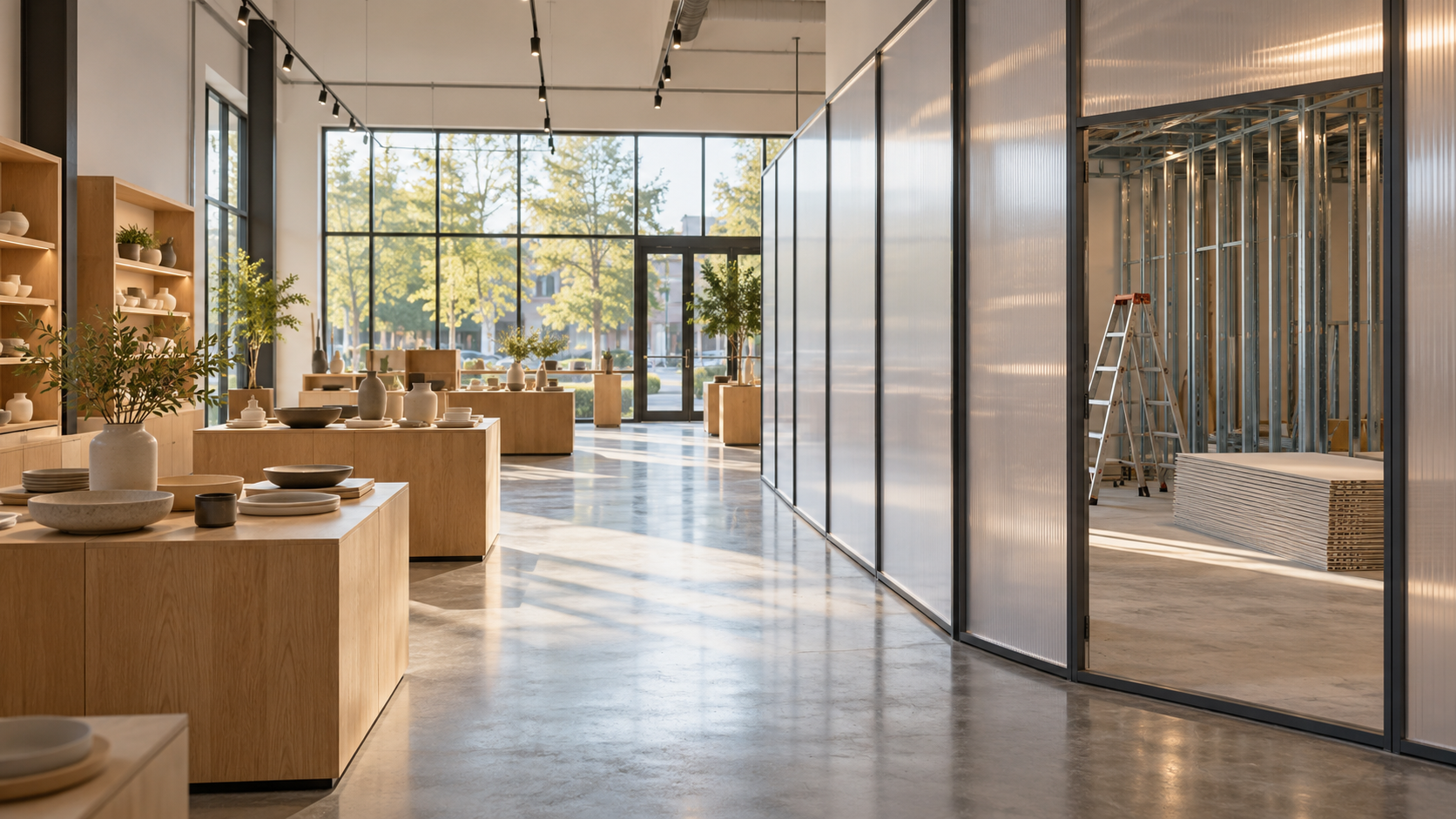
For example, an office might relocate employees to one side of the building while the other side is renovated. A retail business might temporarily reduce its sales floor while improvements move through designated sections.
Phasing can help maintain operations, but it also introduces trade-offs. Crews may need to move equipment repeatedly, install temporary barriers, and complete certain tasks in multiple visits. Work that would be straightforward in an empty building can take longer in an occupied space.
The goal is to develop a sequence that balances business continuity with construction efficiency.
Plan for Noise, Dust, and Customer Access
Some construction activities are easier to accommodate than others. Painting a separated office area creates different challenges than removing flooring, cutting concrete, or demolishing walls.
Discuss how the project will address:
- Separation between construction areas and occupied areas
- Dust control and protection of existing finishes
- Noise during business hours
- Material deliveries and debris removal
- Customer entrances and employee circulation
- Daily cleanup and secure storage of tools
Temporary barriers alone do not resolve every issue. The construction plan also needs to account for how people move through the building and how disruptive activities affect nearby operations.
Identify Utility Interruptions Early
Electrical, plumbing, heating, cooling, and technology improvements may require temporary service interruptions.
Even when work is limited to one area, the systems serving that area may also support other parts of the building. Replacing an electrical panel, for example, could affect more than the room where the work occurs.
Before construction begins, identify anticipated shutdowns, the areas affected, and the process for communicating them. Some interruptions may be scheduled before opening, after closing, or during a planned low-traffic period.
Unexpected conditions can still arise, but early coordination reduces the likelihood of avoidable last-minute disruptions.
Decide Where After-Hours Work Makes Sense
Evening or weekend construction can help keep disruptive work away from customers and employees. However, it may come with additional labor costs, limited delivery options, and scheduling constraints.
After-hours work is often most useful for specific activities rather than the entire project. Demolition, noisy installations, or utility connections may benefit from a separate work window, while quieter tasks continue during the day.
Ask your contractor to explain which activities justify after-hours scheduling and how that decision affects the estimate and completion timeline.
Understand When a Temporary Closure Is the Better Option
Keeping a business open throughout construction is not always practical.
Extensive demolition, major system replacements, limited access, or the inability to separate occupants from construction may make a temporary closure necessary. In some cases, a short planned closure can allow concentrated work that would otherwise require a longer period of disruption.
Compare both options before committing to a schedule. Consider construction costs alongside staffing, temporary relocation, customer inconvenience, and the potential effect on revenue.
Remaining open should be a planning decision based on the actual scope and building conditions.
Set Expectations Before Work Begins
An occupied renovation requires ongoing communication between the business, property management, and construction team.
Designate a primary contact, establish how schedule changes will be shared, and give employees advance notice of access restrictions or disruptive work. Customers may also need clear information about temporary entrances, adjusted hours, or unavailable areas.
A predictable communication process helps everyone respond when conditions change.
Plan Your Commercial Renovation With TBC Development
Renovating an active business takes coordination beyond the construction work itself. Phasing, access, utility interruptions, and daily operations all influence how the project should be planned.
TBC Development works with commercial owners and tenants to evaluate renovation needs and develop an approach suited to the space and project scope.
If you are considering improvements to an occupied commercial property, contact TBC Development to discuss your project.
Email us today @ info@txcommercialconstruction.com or call us @ (469) 584-0483.